
Why deepform
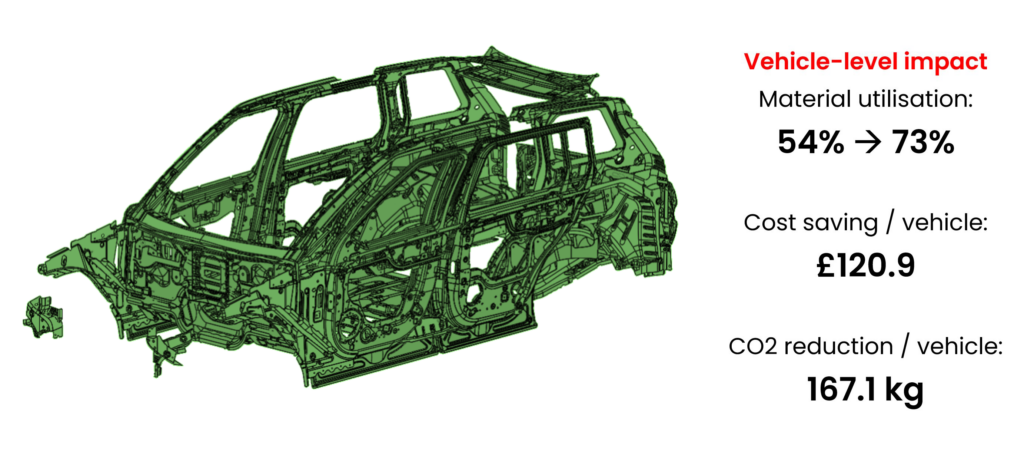
DeepForm’s patented metal forming folds the blank over a template instead of drawing it through a die. The result is a drop-in alternative to conventional stamping – producing deeper, more complex automotive panels from up to 40% less material, with no changes to your existing press lines.
The ROI Use Case
Learn how DeepForm’s technology can offer a 12-month payback on the cars you already build.
Our Partners Include


why OEMs’ work with Deepfrom
Less metal, formed in by design
DeepForm forms the panel without a blankholder, removing the trim allowance that conventional deep drawing requires
- Up to 40–50% less sheet metal per part
- Lower exposure to material price volatility
- Improved programme economics
Drop-in tooling, not a new press line
DeepForm is delivered as replacement press tools, engineered to run in your existing line
- No press, line or infrastructure changes
- Compatible with current production environments
- Faster to deploy than new equipment
Form beyond the deep-drawing limit
The process exploits the mechanics of pure-shear, enabling minimal thickness changes during forming and thus enables
- Deeper, more complex geometries in a single piece
- Lower forming forces, reducing press load and tool wear risk
- Reduced draft angles, which is especially valuable for battery enclosures, where straighter walls can increase usable internal volume for battery storage
Technology | Impact
The Deepform approach
By folding the blank before forming, DeepForm eliminates the need for a blankholder and reduces excess material at the source.
The fold collects excess material into conical tool regions at each corner. As this material deforms, it approaches a near pure-shear state, suppressing thinning and enabling geometries beyond the practical limits of conventional deep drawing.
The result:
- Lower forming forces
- Substantially less scrap
- Greater forming depth in a single step
- Delivered through tooling, not infrastructure change

Proven Path to Production
We work alongside OEMs and tooling partners to deliver:
DeepForm is past proof of concept. The process is patent-protected, simulation-validated, and entering production with a major UK OEM in 2026.
Identification of high-impact components
Simulation-led validation (AutoForm)
Tool design with existing suppliers
Production support and technology transfer
A major UK OEM enters full-scale production in 2026, with multiple programmes already in development.
Resources
Find out where DeepForm fits in your next programme.
Book a technical consultation. We’ll work through candidate components with you and assess the material, geometry and tooling impact.