
Most vehicle programmes carry a cost-reduction target for the body structure, and OEMs worldwide are under pressure to use less material. The usual levers for hitting that target sit in the next model, several years away. DeepForm offers one that works on models already in production. By replacing their existing press tooling, OEMs can save around £85 on every vehicle and, at typical production volumes, recover the cost of the new tools in around 12 months.
Where the cost sits
Automotive panels are drawn from flat blanks. To reach the curvature designers want without wrinkling or tearing, each blank carries addendum surfaces and a broad perimeter of excess material held in the blankholder. That material is trimmed off after drawing. It is collected and recycled, but it has already been bought, cut, transported and pressed.
Across the industry, only 56% of the sheet metal bought for passenger cars ends up in the finished vehicle, according to research from the University of Cambridge. The other 44% leaves the press shop as scrap.
What we assessed
We examined every pressed component in the body structure of a vehicle currently in production and identified 63 as opportunities:
- 38 highly suitable
- 25 of medium suitability
Some tools produce left and right hand parts together, so those 63 components are made by around 40 tools.
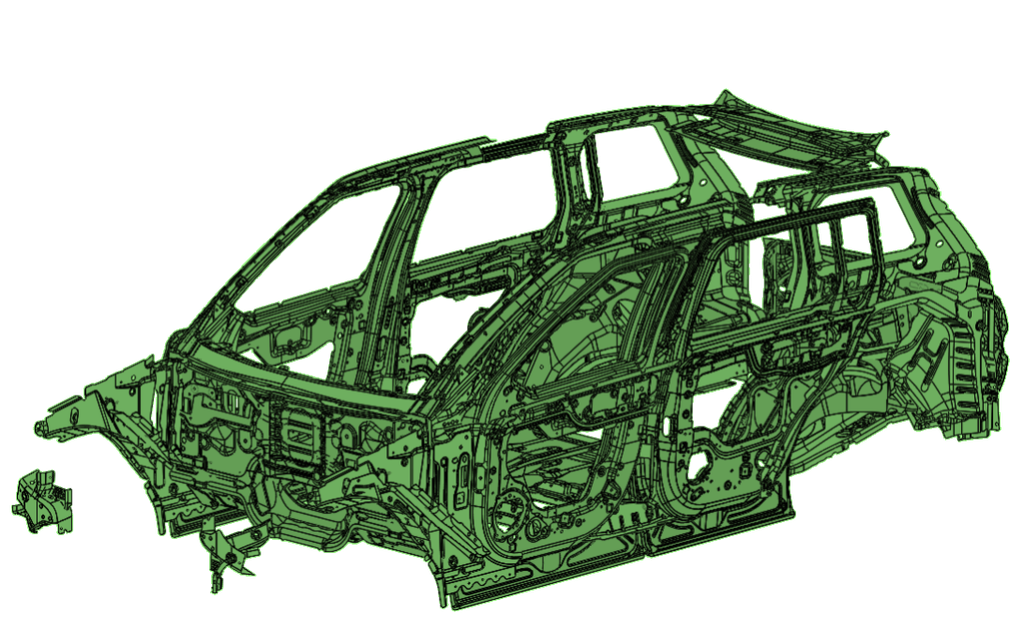
The saving per vehicle
Across those 63 components, average material utilisation rises from 54% to 73% with DeepForm tooling, so the same parts need around a quarter less sheet metal.
For each vehicle, that is worth:
- £85 cost saving
- 170 kg CO2 reduction
Replacing tools, not redesigning the whole process
DeepForm tools are drop-in replacements. They fit into the first or second operation of an existing press line, run on existing presses and can be built by existing toolmakers. The rest of the line, and the part delivered to the body shop, stay the same.
The payback
The new tools pay for themselves through the material they save. Across the suitable parts, that takes around 12 months from installation.
Payback comes sooner on high-volume models. On lower-volume models, starting with the parts that carry the largest savings keeps it within the same window.
After that, the saving continues for every remaining year the model stays in production.
At programme volume:
| Per vehicle | Per 135,000 vehicles | |
| Cost saving | £85 | £11.5 million |
| CO2 reduction | 170 kg | 23,000 tonnes |
The opportunity on new programmes
Tool replacement is the fastest route to a saving. Even bigger opportunities come earlier, at the design stage. Developing the tooling for a new model can take six months to two years, and the decisions made in that window set material cost for the life of the vehicle. Designing parts with the DeepForm process from the outset captures the full saving across the body, with no existing tooling to replace.
It also opens up part designs that conventional drawing struggles with, such as tighter radii and steeper walls, as we covered in A new era of forming deeper shapes.
How we work with OEMs
- Examine the full component set of a model in production, or a new programme, and identify the parts and tools where DeepForm offers the largest saving.
- Design tool surfaces and motions, and confirm in AutoForm simulation that parts are delivered within tolerance and with the expected savings.
- Develop detailed tool designs with the OEM’s preferred toolmakers, and support commissioning and installation on the existing press line.
If you have a model in production, we can run the same assessment on its body structure and show where tool replacement pays back fastest. Get in touch with our team to discuss it.
