
By eliminating the need to grip and trim sheet metal, DeepForm targets one of the largest hidden cost and emissions sources in global manufacturing
In our work in the Use Less Group at the University of Cambridge, we look for opportunities to live well with much less material production. This work is motivated by the need to reduce global emissions, but it also addresses one of the largest and least-examined inefficiencies in modern manufacturing: material waste.
In 2010 we published a pragmatic analysis of the options for decarbonising industry, having spotted that about two thirds of industrial emissions come from making just five materials – steel, cement, plastic, aluminium and paper. Globally, we use extraordinary quantities of these materials. On average, every person alive today, all eight billion of us, “consumes” around 200 kg of steel and 500 kg of cement every year. No other materials are available at anything like this scale, so substitution is not a realistic option. When we examined ways of producing these materials without emissions, it quickly became clear that future supply will inevitably be lower than today’s.
After more than a century of mass production, companies have learned to make these materials very cheaply. Unsurprisingly, this has led to widespread waste. Our analysis showed that we could maintain a high quality of life with much lower levels of material production.
To explore this opportunity in detail, we mapped the world’s use of the five materials, tracing each year’s production from ores, minerals, fuels or biomass to material stock and through manufacturing and construction to final applications. We were surprised by how much material is simply cut off and discarded during manufacturing. For steel alone, we found that around a quarter of global production never makes it into final products.
Reducing this waste offered a powerful lever for cutting emissions, so we dug deeper into its sources. For steel and aluminium, the largest losses came from the processes used to shape flat sheet into curved components. Around half of all metal is sold as thin sheet, but like office paper, these sheets have little stiffness. Before use, they are therefore shaped into flowing curves—the body panels of cars, one-piece drinks cans, or the pipes and vents of office ducting—where shape provides both form and function. While it is easy to fold a sheet along a straight line, shaping it into a smooth, doubly curved surface is much harder.
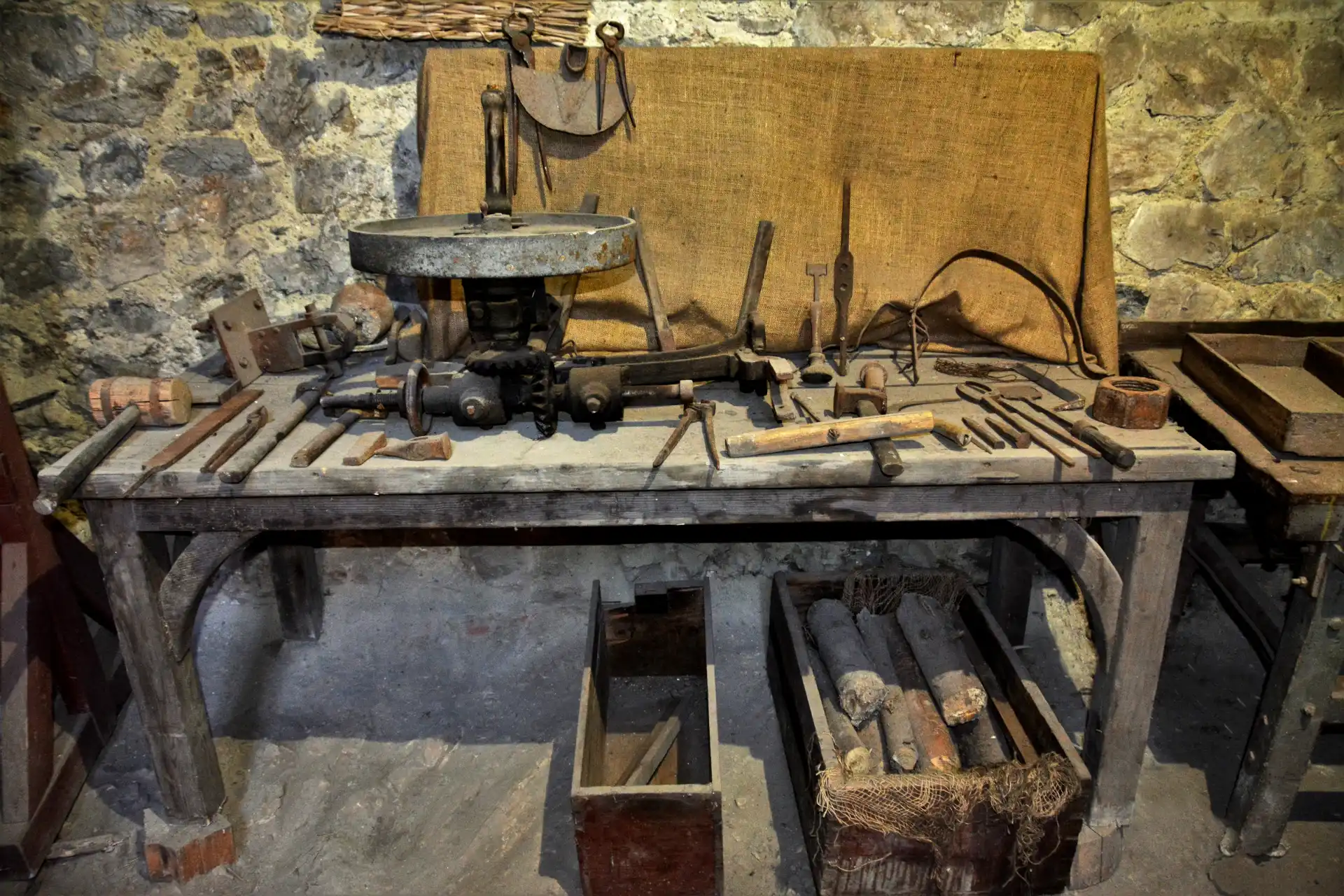
If you try to fold a piece of paper over a coffee cup, it wrinkles, familiar from the pastry cases of coffee shop temptations. Ancient metalworkers faced the same problem. Hieroglyphics in the funeral chamber of Rekhmire show Egyptian craftsmen forming cups step by step over a slender anvil, hammering out wrinkles as soon as they appeared. The gold cup of Ur, made around 2,200 BC and now in the Penn Museum in Philadelphia, was produced this way. By the fifteenth century, European trumpet makers had developed a different approach, spinning flat metal discs on a lathe and gradually pushing them onto wooden templates.
These approaches worked—but they were slow. Since around 1880, mass production has relied instead on deep drawing. In this process, the sheet metal is gripped loosely at its edge, while its interior is pressed between a male and a female die. The grip suppresses wrinkles, while allowing material to slide inwards to prevent tearing. However, all the material that slides through the grips must be cut off and that’s the biggest source of scrap we found in our global analysis.
This raised a simple question: could we form smooth, curved parts from flat sheet without gripping the edges at all?
In 2015, without any solutions in mind, I spent several days trying out ideas in my garden shed, working with Omer Music now DeepForm’s Head of R&D. We used garden mesh as a model material, fashioned a wooden template of a representative corner, and explored different ways of pushing the mesh into shape. Our instinct was to start by folding the mesh – using origami techniques – to get as close as possible to the final form. Instead of many small wrinkles, all the excess material gathered into a single cone at the corner.
Cones are stiff. Without gripping the sheet edge, we could push against this cone with our thumbs, working the excess material down onto the template. With practice, we produced a good match to the desired shape, leaving a small tab of excess material that could be trimmed away. Crucially, this allowed us to control material flow locally, rather than restraining the entire sheet.
This simple experiment – easily recreated with an uncooked sheet of pastry over a jam jar – is the basis of the DeepForm process. A few days in the shed provided the starting point. We returned to the lab to develop simulations and controlled experiments with real sheet metal, and soon afterwards Chris Cleaver, DeepForm’s CEO, recognised that the process could be implemented using new tooling within conventional stamping lines.
The DeepForm journey continues as we learn just how much material can be saved across a growing range of applications. By reducing scrap at its source, the process offers manufacturers a practical route to lower costs and lower emissions — without abandoning the production systems on which modern industry depends.
